Rebuilding Place in the Urban Space

A community’s physical form, rather than its land uses, is its most intrinsic and enduring characteristic. This blog focuses on place and placemaking and all that makes it work--historic preservation, urban design, transportation, asset-based community development, arts & cultural development, commercial district revitalization, tourism & destination development, and quality of life advocacy--along with doses of civic engagement and good governance watchdogging.

Friday, July 16, 2010

Feel good surveys versus focusing on substance

DC's Department of Consumer and Regulatory Affairs has a survey up on "improving street vending." This is an issue I have paid attention to over the years. While I haven't been involved with the issue directly, I've spent a fair amount of time with some of the people who were very active in the issue for a long time.

The problem I have with surveys like this is that generally customer surveys find that people will buy X or Y or want access to X or Y, etc., but for the most part customer interest isn't the issue.

The reality is that the issue with "improving" street vending is no different from "improving" retail in neighborhood commercial districts.

Customer interest is less of an issue than these four issues:

- number of available customers (also location)
- creativity of potential entrepreneurs/store owners/cart owners
- access to capital (doing anything other than hotdogs and chips is more expensive) both for equipment and inventory
- the regulatory environment/barriers to entry/opportunities to participate presented by the DC Government (such as requiring higher end and much more expensive carts, etc.)

Here are the survey questions:

1. How often do you eat food from one of DC’s street vendors?
2. If you do eat food from vendors, what kind of food do you eat from street vendors?
3. Are you most likely to:
4. How far would you travel to eat at a vendor?
5. Are there areas of the city where you'd like to see more vending?

(A key issue is segmentation. Office workers are a distinct daytime segment. But they are hard to reach, and increasingly people have less time for lunch/eat at their desk, etc.)

Another problem is that DCRA sees street vending more as a revenue issue--getting the licensing fees--rather than as something more entrepreneurial, and about how vending contributes (or fails to contribute) to vital places.

Am I wrong in thinking that the DCRA survey is somewhat pathetic?

New York City offers some interesting resources:

-- Street Vendor Project of the Urban Justice Center
-- Vendy Awards acknowledging innovative street vending
-- publications
-- Inclusive Cities webpage on street trading/vending
-- Center for Urban Pedagogy Street Vendor Guide
--New York Street Food blog

In places like San Francisco/The SF Bay region and Denver, more established restauranteurs are getting involved in street vending, partly to broaden their revenue sources. See "Oakland to debut street food fest" from the San Francisco Business Times.

Labels: , , , ,

How not to build support for municipal unions...

See "Hamden mayor painting the town clean (video)" and "Union files grievance on Hamden mayor's graffiti removal (video)" from the New Haven Register.

Hamden Mayor Scott Jackson paints over graffitti at on underside the Rt 15 overpass located at Wintergreen ave near Carbonella Dr. 07/12/10 VM Williams/Register

Labels: , , , ,

New York City isn't perfect either?

I write stuff in this blog, reasonably critical of stuff often in DC, and people will comment to me that DC functions pretty well all in all. I thought about that in terms of how I sometimes think of things in NYC, reading Streetsblog or emails from Transportation Alternatives--after all, compared to DC, New York City's doing a lot more in terms of sustainable transportation, especially in biking.

But the reality is that it's all relative, and we always have to sstrive for greatness and "better-ness" in our own communities.

So I was struck by this entry in the latest issue of the Transportation Alternatives e-letter:


The NIMFY Problem ("Not In My Front Yard")

As a grassroots, member-supported organization deeply invested in community-based planning, we're all for friendly neighborhood discourse -- even the occasional furious disagreement -- but lately a group of Park Slope residents has embarked on a campaign of misinformation and slander that seems right out of Karl Rove's playbook.

"Not in my front yard!" they're screaming about the new Prospect Park West bike lane, while claiming it was forced down the neighborhood's throat, installed without warning and that it's a "danger to pedestrians and cyclists."

Yikes. Where to begin?

The Department of Transportation installed the two-way traffic-protected bike lane as a pilot project on Prospect Park West from Grand Army Plaza to 15th Street with the encouragement of 1,500 petition signatories, the local Community Board, two well-known neighborhood groups and both of the area's City Councilmembers. T.A. trumpeted the lane for months, and it received a good deal of media coverage long before this brouhaha, so if people were unaware or felt uninformed, it is more likely a product of their own inattention than some sort of malevolent cabal.

As for safety concerns, the DOT's study is still underway -- that's part of the pilot program -- but if other bike lanes around the city are any indication, the street will get a whole lot safer. On Manhattan's 8th Avenue, the installation of a bike lane reduced crashes by over 50 percent and reduced injuries for all street users -- cyclists, pedestrians and drivers, by 51 percent. Anecdotally, the rave reviews from cyclists, pedestrians, pundits, neighborhood cranks and motorists that have appeared on message boards, in local papers and on the wall of a quickly growing Facebook group indicate that the lane is doing its job. If it's not, the City will soon find out.

In the meantime, we urge you to join this Facebook group, sign this petition and contact Councilmember Brad Lander about the Prospect Park West bike lane. Tell the Councilmember what you think of the lane and be honest. Informed facts, hard data and community input are an essential part of any good planning process. Absent those, you've got yourself a NIMFY problem.

Making improvements in places is hard everywhere, and everywhere, people's inclinations are to oppose. And the opposition generally doesn't focus on facts and figures, but impressions. And impressions are often very subjective.

Labels: , , ,

Speed bumps

This week's Current reports in "Humps halted to allow community input," that the neighborhood traffic calming program in DC doesn't have a set of standard decision criteria on which to make decisions about whether or not to install speed bumps. They just do it--provided 75% of the residents on a block agree to it.

From the article:

The Transportation Department had planned to construct the three speed humps this month after receiving a petition requesting the traffic-calming devices signed by 75 percent of the block's residents.

The petition observed that drivers tend to speed down the street and agency engineers determined that the street met basic requirements for speed humps. Some streets, such as those on steep inclines or bus routes, are ineligible for humps. ...

Chamberlin explained that the agency's approach to traffic calming has changed a few times in recent years. Prior to 2008, any time residents requested traffic calming, the Transportation Department would respond by conducting a lengthy study. Agency officials would determine whether there was a speeding problem, make recommendations for combating it, and then put in place traffic-calming devices like speed humps.

"What came out of this, unfortunately, was a backlog." Chamberlin siad. "And we were getting a lot of complaints.

So the department changed its speed-hump policy. No longer did a street need to have a speeding problem. rather most residents (75 percent) on a block had to want speed humps, and the street had to meet basic engineering requirements.

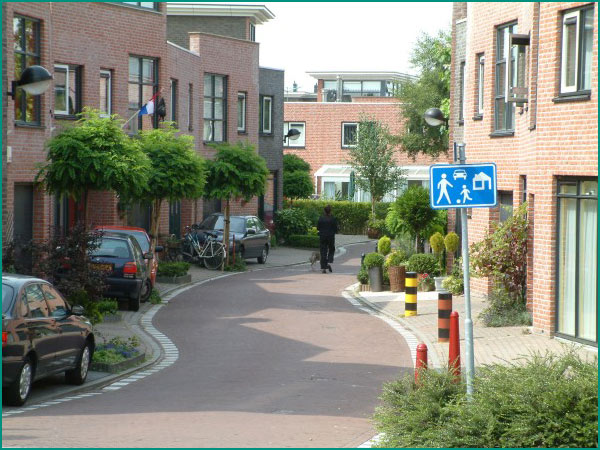
The reason I generally am against speed bumps is because I think the real issue is re-engineering neighborhood streets to more naturally be driven at neighborhood-appropriate speeds. Something like the idea of woonerfs.
http://transportehumano.files.wordpress.com/2009/04/woonerf-a.jpg
Image from the ASLA Dirt blog interview with David Owen.

Most jurisdictions with traffic calming programs have specific processes in place to determine need and appropriateness. E.g., the program in Baltimore County or Tempe, Arizona makes very clear how to go about the process, and at least in Baltimore County, only streets where a problem has been confirmed are eligible for the treatment.

The Tempe manual is an excellent explication of the various types of treatments that are possible and the types of problems and streets where the city has determined that their use is appropriate.

Note that bicycle boulevards are a form of traffic calming too, and that the techniques for creating bicycle boulevards aren't much different from typical traffic calming programs.

Anyway, I think it's crazy to have a "just do it" approach to speed bumps without an objective set of criteria in place to guide the process.

Labels: , ,

Thursday, July 15, 2010

It's not enough to be smart, you have to be productive too

Today's Post has an article, "D.C. area ranks as the best-educated in the country:Study ranks D.C. area as the nation's best-educated," about how the Washington region has the most educated population in the United States. Too bad so many of the people with advanced degrees in the Washington region are lawyers...

It's not that lawyers aren't necessarily productive, but it does depend on the kind of law they practice. So much of government-related law is about manipulation or "rent seeking"-- it's not about rebuilding and extending "...the wellsprings of innovation and international competitiveness..."

As long as a preponderance of the region's best educated focus on rent-seeking, the country will not grow its way back to innovation.

When I go on vacation, part of my vacation is voraciously reading the locally available newspapers. (It also happens that Montreal has a large number of independent bookstores, and many many periodical stores, both of which are in serious decline in DC and in the U.S. more generally.)

That meant that while I was in Montreal, I read the Montreal Gazette, Toronto Globe & Mail (Canada's "national" newspaper with a role comparable to that of the New York Times in the U.S.), and the National Post (owned by a company which also owns local newspapers and a goodly amount of its stories may appear in the local papers), with occasional acquisition of the Toronto Star and the Ottawa Citizen (Ottawa is the national capital). (And I have clipped tons of stories that will lead, eventually, to a number of blog entries.)
http://financialpostopinion.files.wordpress.com/2010/07/greatresetcover.jpg
In the Ottawa Citizen, there was an op-ed, "Why Canada needs a Great Reset" by Richard Florida, focusing specifically on Canada in terms of the five major points he made in his latest book.

I was most interested in point 3:

3) Speed up the velocity of people, goods and ideas. We need to connect our mega-regions with high-speed rail. The line connecting Windsor, Toronto, Ottawa, Montreal and Quebec City is an absolute priority. But high-tech solutions are only part of the answer. We need to rebuild our cities and mega-regions denser, with faster and less-stressful modes of transportation: mass transit, walking, and biking. Canada already has an advantage here. Eighty per cent of its people live in two per cent of its land area. And its top five city-regions produce 53 per cent of its total economic output, compared to just 23 per cent for the top five U.S. regions. While money is part of what's needed, we also need to do a lot of creative thinking about how people travel. If we do it right, there will also be less congestion for those who want and need to drive.

But for once, I was interested not in terms of the transportation aspect of "velocity" but in terms of the primacy and innovativeness and creativity of ideas and the willingness to challenge and supercede conventional wisdom and thinking, and mediocrity--to create knowledge, ideas, and products, not merely pass a law...

Rent seeking is about maintaining mediocrity and power, and that too often is what political "reform" is all about, making marginally incremental changes (sometimes improvements) while giving various well-connected sectors a free pass. E.g., a recent example is how car dealers--some of the worst offenders of manipulating the provision of credit to customers for business advantage--got exempted from being covered by a new consumer protection board.

The Philadelphia Inquirer columnist Karen Heller wrote a piece a couple weeks ago, "Pennsylvania, home of people who stay in Pennsylvania" about how people who stay in one place often are provincial or chauvanistic. From the article:

When your world is small, you tend to think small. You take for granted the bounties that you have while believing that what's inexorably wrong can never be fixed. You're not prone to adventure. You believe the broken way of our government is the way that all governments work, and you give up trying to change the system or your situation. You accept the inadequate leadership, the status quo.

With an enveloping love of home often comes a distaste for risk and a fear of innovation. And all of this comes at a price of stagnation.

Change, as someone once said, is good.

Now we can't claim there isn't a fair amount of "velocity" of population change in the DC region (although DC proper has a particularly high level of stasis in the African-American population), but maybe there is less mixing up of ideas and imagination and approaches regardless of where people come from.

A number of years ago, the heritage/economic development program Handmade in America (North Carolina) did a report on the creative economy in Asheville, Mapping Creative Communities: The Impact on Real Estate, with a definition of contributing professions slightly different from that employed by Richard Florida in The Rise of the Creative Class.

Basically, I'd say that we need to drill down from the Census data and look at a much finer level of detail at the kinds of advanced degrees that typify the local population and determine whether or not the "best educated" are actually contributing to "innovation and international competitiveness."

The lobbyist lawyers are probably contributing a lot less to the economy than the lawyers whose practices focus on working with entrepreneurial firms in the software field, etc.

If we started looking at educational attainment data in this fashion, maybe we could start rethinking questions about the strength and viability and future of the American economy.

Here's a document I'll have to read...

Press release from the Washington DC Economic Partnership:

Comprehensive Economic Development Strategy Available for Public Review
District completes document as prerequisite for federal funding opportunities

The District of Columbia is pursuing an avenue of federal funding from the Economic Development Administration (EDA) through the development of a Comprehensive Economic Development Strategy (CEDS) which will bolster the City’s investment priorities. The EDA can provide funding for municipalities for economic development projects on an ongoing basis if a CEDS has been completed.

A Comprehensive Economic Development Strategy (CEDS) is designed to bring together the public and private sectors in the creation of an economic road map to diversify and strengthen local economies. The CEDS should analyze the local economy and serve as a guide for establishing goals and objectives, developing and implementing a plan of action, and identifying investment priorities and funding sources.

The drafting of a CEDS for Washington, DC took place over the course of the last year, and was jointly undertaken by the Office of the Deputy Mayor for Planning and Economic Development, the DC Office of Planning and the Washington, DC Economic Partnership. To view a draft of the Washington, DC Comprehensive Economic Development Strategy, please click HERE. The draft will be available for public review from July 1 to August 1. Public feedback should be submitted to [email protected] by August 1, 2010.

Labels: , , ,

Monday, July 12, 2010

Retail planning for the 18 hour city

I have a concept that needs to be more fully developed, about planning the retail and entertainment mix for commercial districts by daypart (time of day) and customer segment. It's described in somewhat more detail in the report, A Commercial District Revitalization Framework Plan for Downtown Cambridge, Maryland, on pages 15-18.

But in response to a query I was looking again at the British Council of Shopping Centers website (in 2002 they published a very good report on Urban Design for Retail Environments) and found an interesting report on planning for night-time commerce. See:

Better Towns Centres at Night: Raising the Standard and Broadening the Appeal (2010)

Labels: ,

Where is the big thinking on big issues? Transit in the DC region

Before I went off on vacation, I managed to speak at the hearing that the MWCOG-Board of Trade task force held on "WMATA governance." GGW blogged about the issue here, "Dear COG and Board of Trade: Democracy is healthy."

Now I don't really think the issue is "democracy" per se, but figuring out what your desired outcomes are, and getting the right system and set of processes in place to generate those outcomes, and coming up with the right governance structure.

While I do believe in democracy, and I probably believe that the WMATA board should be directly elected, the issue is how to do regional transportation planning and regional transit service--what in my transportation planning framework I actually call "metropolitan" transportation planning and metropolitan transit service.

We have badly working leadership on the board of WMATA and we don't have effective transportation planning in the metropolitan region either. The car remains king.

My testimony was about how this is what needs to be addressed, in toto, not just the question of the WMATA board and the process by which the board is presently appointed.

(I did a presentation about metropolitan transportation planning at the University of Delaware in March but I am only just now getting around to posting it, although problems with my home computer mean it'll be another day or two before I get the March presentation online at Scribd, although I will say it's drawn from various blog entries over the years, so to me it's nothing new).

Frankly, I'm with the conventional wisdom that the board of directors for WMATA isn't working--except for the appointees from Northern Virginia, there's not a whole lot of regional leadership being provided by the board members.

OTOH, I differ from the conventional wisdome that having the Governors of Maryland and Virginia and the Mayor of DC appoint the directors (plus the federal appointees) will make things better.

I don't have my notes handy from the hearing, but a few people made some good points (including me) although the chair wasn't always interested in hearing them. I did find it interesting that in the comments responding to the testimonies by the various task members, that it was the public officials on the task force (plus Ron Carlee, an ex-public official) that were most clued into the necessity for broader thinking, public involvement, etc., in the process.

One speaker was from the Dulles Corridor Transportation Task Force, who argued two things: (1) that transit beyond the beltway is the most important issue and (2) that the fact is that expert appointees to boards such as the Metropolitan Washington Airports Authority actually do quite a good job.

Now, the reality is that WMATA's task is not providing transit outside the Beltway so much, especially in the exurbs. The more distant and less populated the destinations and origin points, the much more difficult it is to make transit work effectively. But I will say that this is an issue for metropolitan transportation planning...

Having spent about 10 days in Montreal earlier this month, the differentiation in their system between service in Montreal--subway and bus, with limited extension beyond Montreal to Longeuil and Laval on subway--and commuter trains serving the region beyond Montreal (although the train service actually serves a number of stations in Montreal as well) complemented by bus service provided by the various municipalities, I spent more time thinking abou the difficulties posed by the fact that the WMATA subway service is a hybrid providing both intra-city transit in places like Washington and Arlington County, while providing service more comparable to commuter rail in the other part of the system.

Montreal--both the city proper and the region--has similar transportation issues. The core of the city is well served by the subway and bus and the fact that the core was built during the Walking City and Transit Eras of urban design means that transit works very well there.

But the rest of the region is for the most part car-centric, and the outskirts of Montreal is much more car-centric than the core. And as I blogged last week, some of the arondissements in Montreal are very much focused on quality of life-active transportation agendas, and there is just as much opposition to this from the car-centric areas as there is anywhere in the U.S. when similar kinds of proposals are raised (i.e., bike lanes, streetcars, etc.).

(FWIW, we were in Montreal for 9 days and did not set foot in a car once--we walked, I biked some, and we took the subways, with some bus riding.)
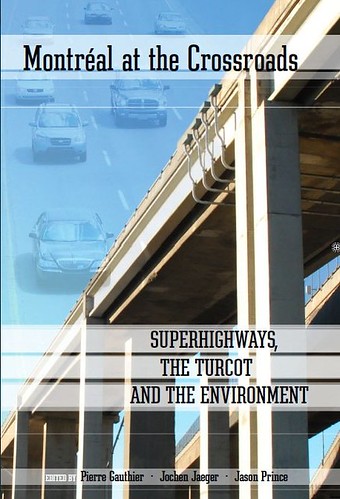
montreal at the crossroads book cover
Interestingly, some of this is addressed in the book Montreal at the Crossroads: Super Highways, Turcot and the Environment, which looks at the issue of the rebuilding of local highways as an opportunity to rethink traditional forms of mobility and refocus attention and resources on public transit.

It is this kind of broader and visionary thinking that I wish would be happening right now as it relates to WMATA and rebuilding the region's consensus about the role and value of transit.

I am hopeful, but not expecting that the COG-BOT process will lead to the necessary visionary thinking and process that the region desperately needs.

See the past blog entry "St. Louis regional transit planning process as a model for what needs to be done in the DC Metropolitan region" for my point that a wide-ranging public process, not a closed process limited to the traditional political and economic elite, is necessary within the DC region to restore the role of and trust in public transit, specifically with WMATA.

Labels:

Summit for New York City local issues

Christopher sends us this notice...

via News from the Municipal Art Society of New York by Nadia Chaudhury on 7/12/10

MAS is proud to announce the inaugural Summit for New York City, a unique gathering of civic-minded New Yorkers and leaders in the fields of urban planning, urban design, housing, economics, and research and development. This cross-section of accomplished thought leaders will gather on October 21 and 22 to discuss key issues and challenge the current thinking about New York City’s livability.

The program, currently in formation, will include thought-provoking presentations, panels and keynotes, as well as smaller sessions that will enable the audience to participate more fully in the debate about our city’s future. For more information, updates, and registration, click here.

Labels: ,

Sierra Club meetings on "moving the region forward"

From email: Introduction:

How Do We Move Our Region Forward

A Community Discussion Hosted by the Sierra Club

Tuesday, July 13th and Wednesday, July 14th

6.30 pm - 8.00 pm

You are invited to join local leaders in a conversation to define how we can advance goals of common interest by using use the Council of Governments Region Forward Report to explore the regional and jurisdictional interplay of issues related to environment, transportation, and housing. The conversation will begin with an overview of the report, and how it is currently being used to advance priorities within DC (DC Meeting) and throughout the region (Arlington Meeting). The meeting will then shift to a facilitated discussion on the most effective way to mirror federal initiatives by coordinating diverse environmental, social, and economic organizations to advance our shared priorities and improve efficiency.

Space is limited, so please RSVP by contacting Sierra Club's Sustainable Metro DC Coordinator, Phillip Ellis at phillip.ellis@ sierraclub. org or 202.320.2044

The future of planning within our country is changing. The energy economy is shifting along with peoples lifestyle choices. And the recession has produced unprecedented budget deficits. As local governments seek other funding sources to address infrastructure needs, the federal government is exploring strategies to improve planning and efficiency by integrating and coordinating the missions of specific agencies. The Environmental Protection Agency, Department of Housing and Urban Development and Department of Transportation are now cooperating to advance shared priorities. Notably, livable communities are being promoted through a results-driven grant program that emphasizes a regional approach. To secure funding from these new revenue sources in the DC region, our local leaders must mirror the federal initiatives by coordinating diverse environmental, social, and economic organizations to advance our shared priorities and improve efficiency.

A significant first step in identifying regional priorities was taken when the Council of Governments spearheaded the "Region Forward: A Comprehensive Guide for Regional Planning and Measuring Progress in the 21st Century" that was approved by the COG Board and published in January 2010.

We envision the next step is to bring a cross-section of local organizations together to discuss how we can advance common goals. The Sierra Club, in cooperation with the Washington Council of Governments and local Governmental leaders, presents the following outline toward that end.

Goals:

We will use the report to explore the regional and jurisdictional interplay of issues related to environment, transportation, and housing - and determine how these issues interact to create more or less livable and sustainable communities. We hope to take steps toward identifying a shared agenda among participating organizations with some prioritization of goals. In the process we expect to increase public awareness of, and demand for, the report’s objectives while recognizing the leaders in our community who are bringing the vision to reality.

Specific Task:

Prioritize 5 goals from the Region Forward report which are of common interest to participating organizations that we can collectively advance. -Establish a process for follow-up.

How DC Moves Forward | Led by Harriet Tregoning and David Robertson

Tuesday, July 13th | 6.30 pm - 8.00 pm

Council of Governments Training Center

777 North Capital Street NE, DC 20002


How the Region Moves Forward | Led by Chris Zimmerman and David Robertson

Wednesday, July 14th | 6.30 pm - 8.00 pm

NRECA Conference Center

4301 Wilson Boulevard, Arlington, VA 22203

Labels:

Environment Maryland's report on Maryland commuter rail

Report: On the Right Track: MARC Saves Energy and Protects the Environment and News Release. From the executive summary:

Each year, the Maryland Area Rail Commuter (MARC) system saves area travelers about 7.1 million gallons of gasoline - the same amount of fuel consumed by more than 12,000 cars annually.

Transportation is responsible for more than two-thirds of our nation’s oil consumption and nearly a third of our carbon dioxide emissions. To reduce pollution and our dependence on oil, we need transportation alternatives that use less energy.

MARC is a great example of how we can reduce energy consumption, curb our dependence on oil, and minimize pollution, while at the same time improving our quality of life, saving commuters money, and strengthening the economy.

More than half of all Maryland residents live within five miles of the MARC system, which traverses the state from West Virginia to the tip of the Chesapeake Bay. MARC strengthens the link between Baltimore and Washington D.C., allowing commuters to travel by rail between work and home from across the state along three lines:

  • Penn: Service between Washington, D.C., and Perryville, MD;
  • Camden: Service between Washington, D.C., and Baltimore; and
  • Brunswick: Service between Washington, D.C., and Martinsburg, WV.

MARC ridership has increased steadily, averaging about 6 percent annual growth over the past decade.2 In 2009, riders made 8.1 million trips on MARC, or more than 30,000 trips per weekday.3 The current MARC Growth and Investment Plan projects significant expansion in the decades to come, potentially reaching more than 100,000 trips per day by 2035.

MARC Reduces Energy Consumption, Oil Dependence and Pollution

Travel on MARC trains uses less energy than travel via automobiles, helping to curb dependence on oil. Rail cars carry more passengers than automobiles. A single MARC train can carry hundreds of passengers, replacing hundreds of car trips and enabling highway traffic to flow more freely – reducing the amount of fuel wasted in traffic jams.

MARC’s energy efficiency, combined with avoided highway congestion and the role of MARC in bringing about less auto-dependent forms of development, results in a reduction of overall energy use by an amount equivalent to 7.1 million gallons of gasoline per year.

MARC also emits less global warming pollution than automobiles. Each year, MARC service averts 51,000 metric tons of carbon dioxide pollution.

Tripling ridership on MARC would reduce traffic congestion, encourage compact growth near rail stations, and provide an alternative to auto commuting, thereby reducing energy use and pollution.

Labels: ,

Friday, July 09, 2010

Frameworks for high frequency surface transit

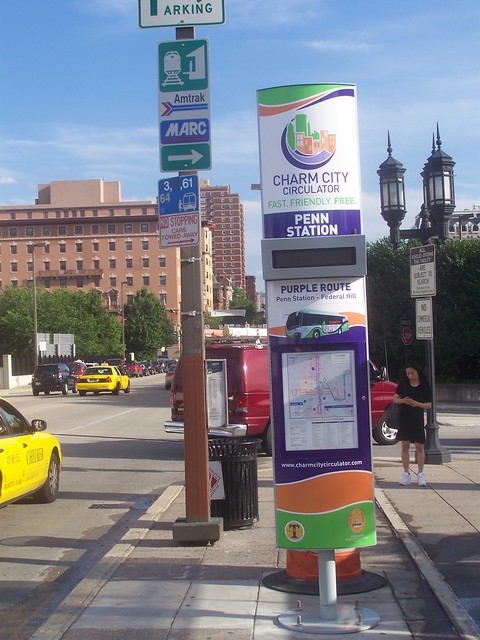
I was quoted in this piece, ``Green Machine: The Charm City Circulator is more than a cool free bus--it's part of a hopefully sustainable relationship`` in the Baltimore City Paper about the Charm City Circulator. The main thrust of the piece is that Veolia Transportation is taking an ever bigger piece of the transportation pie in Baltimore City as they also own Yellow Cab as well as manage and operate the Circulator for Baltimore City. Plus a different division does water treatment. And another part operates the bus service for Johns Hopkins University.

I was hoping the article was going to be a cover story, because it would have been able to cover much more. (I talked with the journalist for over an hour.) A big part of the conversation was how to provide high frequency transit service in the core of the center city, how to reposition the value and perception of transit, not to mention various issues about privatization and how this may well impact the power of transit unions. (In Baltimore the MTA service, comparable to WMATA, is represented by the Amalgamated Transit Union, while the Circulator is not. It`s the same in DC, WMATA workers are represented by unions, while the Circulator bus service, run by a division of the Downtown BID through a contract with DC Government, is not.)

My quote, in this paragraph:

If that works, it could spark a change in the way Baltimore views public transit. "The Circulator does something that the MTA doesn't do," says Richard Layman, a blogger (urbanplacesandspaces.blogspot.com) who has worked as an urban planning contractor for Baltimore County. "It's helping to reframe how people think of transit. The prevalent belief is that only poor people ride trains. This is beginning to reposition transit."

needs to be clarified:

This is a fragment of the broader point I was making, it`s not just that the Circulator is free or that it isn`t MTA (which can help set new service metrics for and expectations for transit service in the region, not just for MTA in general, but for the workers and for the Union specifically in how it conceptualizes its role as a representative of workers who in turn need to help satisfy the needs of customers), it`s that by overlaying a framework for high frequency transit service within the core of Baltimore City (intra-city transit), through the Circulator, the opportunity to reframe the value, efficiency, and effectiveness of transit is offerred.
photo
The Charm City Circulator has a great set of information kiosks with complete maps that are useful to passersby whether or not they use the transit service, including information on when the next bus is expected to arrive. It also markets the transit service in a way that traditional straight up bus signs do not.

photo

Labels: ,

Thursday, July 08, 2010

One more thing about Montreal as a `bike city`

I forgot to include one other aspect in the previous post. Montreal, like areas in Europe, has begun implementing an initiative to reduce posted driving speeds on residential streets. This concept was first implemented almost two decades ago in Graz, Austria, where they reduced speeds to 30 kph and 50 kph. 30 kph is 18.75 miles per hour, and 50 kph is about 30 mph. This initiative has since spread to the United Kingdom, and undoubtedly it is being implemented in other places as well.

Some of the boroughs and the center city district (Ville-Marie) are implementing a 30-40-50 kph policy. There is more about it on the Transport Montreal website.

Plan

The basic point, obviously, is to provide reduced speeds in residential areas. Because the likelihood of injury increases dramatically with the speed of a motor vehicle, for pedestrians and bicyclists involved in car accidents, an overall reduction in driving speed is a health and safety issue, not to mention a quality of life issue as well.

It`s not a policy without controversy, much like the so-called `war on drivers` that the Mid-Atlantic AAA harps about. See `Plateau Mont Royal introduces lower speed limits` and The problem with speed limits is that they are too low from the Montreal Gazette.

Interestingly, today`s papers have some articles relevant to this broad issue. The Plateau-Mont royal arondissement is initiating broader urban design changes to reduce the impact of commuter-based traffic on neighborhood streets, including a proposal to reduce the width of a street in a six block section to about 12 feet from more than 45 feet. See You can't blame the Plateau for trying to cut traffic.

And an article about the change in control of a local single branch department store discusses their interest in expansion is sparked by increased outmigration to the suburbs and the development of competitive shopping centers in the suburbs where their stores can now (hopefully) be successful and competitive. See Ogilvy is looking to expand to Brossard, Quebec City, and Laval. From the article:

Simard said several years ago, it would have been unthinkable to expand Ogilvy to the suburbs, but urban sprawl has seen the store's target, upper-middle class clientele, move out of the city.

"In the 80s and 90s, the economy was centred in Montreal, and the suburbs weren't big enough to sustain that kind of concept," Simard said. "Now we have an explosion of real estate and a migration of population to the suburbs. The shopping experience for high-end products is limited (in the suburbs), so you have people travelling to Montreal to buy their products, or they're buying them in boutiques."

With regard to the Plateau article, another piece sheds more light on the subject, `Montreal`s air quality in decline.` Montreal has three local political parties--probably the national parties are not allowed to run local parties here. And the Projet Montreal group is the most green and focused on sustainable transportation. From the article:

Under a smog-filled sky behind city hall and in stifling heat, Bergeron held a news conference to denounce Premier Jean Charest's announcement two weeks ago that the province will spend $310 million to add more lanes to Highway 19 from Highway 440 in Laval to Highway 640 in Bois des Filion.

Bergeron, who is a member of Montreal's executive committee, said the expansion will bring thousands more cars from the suburbs into Montreal daily.

Josee Duplessis, Projet Montreal's transportation and environment critic, also unveiled a disturbing analysis of downtown air quality deterioration over the past decade. According to data obtained by the city's air quality monitoring network, the number of "good air days" dropped from 267 in 1999 to only 109 in 2009, while so-called "bad air days" increased from 14 to 39 over the same period.

Bergeron said that decline is largely due to the fact that there are 375,000 more polluting vehicles in the Montreal region today compared to 10 years ago.

The Wikipedia article on the Montreal Metro has a good discussion of ideas--we won`t call them plans--for expansion. Clearly an emphasis needs to be put on that. Although the article mentions light rail plans too, undoubtedly pushed because it is cheaper than building tunnels. In fact, an exhibit is in place for the next few weeks about light rail, to promote the idea. I hope to get over and check it out.

Labels: , ,

Wednesday, July 07, 2010

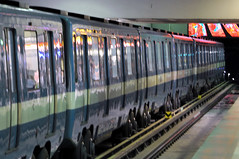
Montreal subway cars have four doors


Metro Cars
Originally uploaded by caribb
(which is something I advocate for in DC, for the WMATA system, to increase the speed at which people enter and exit train cars)

The subway in Montreal is all underground because the system wasn`t built to be weatherproof. Cars are smaller than in DC, but that allowed for cheaper construction in terms of required tunnel width.

They run on rubber tires. I guess the advantages compared to steel wheels are noise reductions and the ability to climb steeper grades. And the trains aren`t air-conditioned, which is noticeable this week...

Tuesday, July 06, 2010

Is Montreal the number one city for bicycling in North America

Am vacationing in Montreal. We`re staying in a house in `The Village` area, which is about one block away from the Beaudry Metro Station, and five blocks from the Berri-UQAM Metro Station, which is the equivalent of `DC`s `Metro Center`where three of the four lines cross--so getting around by transit is easy, especially combined with bus, of course things are close and you can get to many places on foot.

I know that Portland, Oregon and Davis, California duke it out over which is the best city for bicycling in the United States. And New York City, with the variety of initiatives that have come forth there over the past two years under Transportation Commissioner Janette Sadik-Khan, is a rising contender.

Now I haven`t been to Portland for a few years, so I imagine that it has improved for biking in the intervening years, and it was already a great example of bike commuting and accommodating bicyclists on bridges. Certainly, the Intiative for Bicycle and Pedestrian Innovation at Portland State University is pumping out great information, such as the manual
FUNDAMENTALS OF BICYCLE BOULEVARD PLANNING & DESIGN by Lindsay Walker et al.

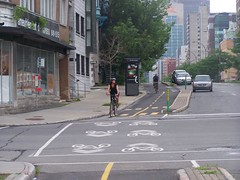
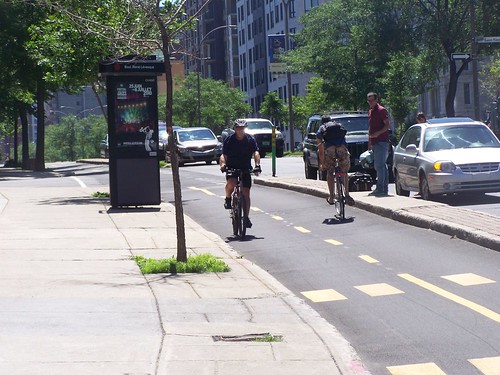
But, seeing how Montreal has an extensive network of piste cyclables or bike paths, which include cycle tracks, or dedicated lanes for bicyclists, located within the road right-of-way throughout the city--and they are used--and function like the cycle superhighways that Boris Johnson claims to be bringing to London and what Tom Vanderbilt writes about in Salon, Bicycle Highways: Should cities build specialized roadways for cyclists? -- although note that this is something that Professor John Pucher of Rutgers University has been saying-writing-researching-presenting-speaking about for many years before Tom Vanderbilt -- clearly the answer is yes.
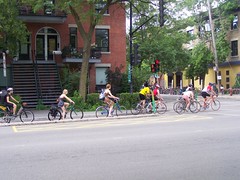
Piste Cyclable on Rue Rachel, Montreal
Piste Cyclable on Rue Rachel, Montreal (across from Park Fairmount).

Although some of the writing is a bit misleading because cycle tracks, while dedicated, don`t have to be separated from the overall roadway, they are placed within it, but in a protected fashion.

The interesting thing about the cycletracks in Montreal is that they are not placed on each side of the roadway, in the same direction as the traffic. Instead, they are two way lanes placed on one side of the street.
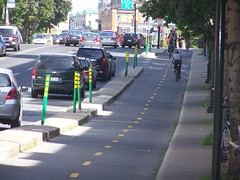
A cycle track/piste cyclable in Montreal

The piste cyclable-cycle track in Montreal

Piste cyclable-cycle track, Montreal

But cycle tracks-cycle superhighways aren`t the only reason that Montreal should be considered the number one place for cycling in North America. Besides the fact that people actually bicycle in the lanes (e.g., I`ve barely seen people use the contraflow cycle track on 15th Street, while the cycle tracks in Montreal are teeming with cyclists--some duded up in cycling gear and clothing, but most not--maybe the cyclists aren`t as pretty as those featured in Copenhagen Chic or Riding Pretty blogs, but they are transportational cyclists nonetheless.
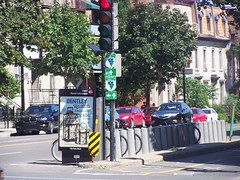
Signs for the Route Verte abut a bicycle  sharing station in Montreal

Signs for the Route Verte abut a bicycle sharing station in Montreal.

There is also the Route Verte or Green Route of cycling routes throughout Quebec. The idea for the Route Verte was initiated by VeloQuebec, the provincial bicycling advocacy group, and after a few years the idea was taken up by the provinicial transportation agency.

Now the Transportation agency has a publication, Making cycling a mode of transportation in its own right, which discusses the provincial bicycle policy and programs to aid àlternative modes of trnasportation to the car.` According to the publicaiton, Quebec is the place in North America where bicycling is most widespread, as proportionally there are 2.5 times more cyclists in Quebec than in Canada as a whole, and 2 times more than in the U.S.

The link to the publication is the longer piece. I came across a four page brochure in an information rack in a local museum (in both French and English).

But then there is Bixi, the bicycle sharing program in Montreal.
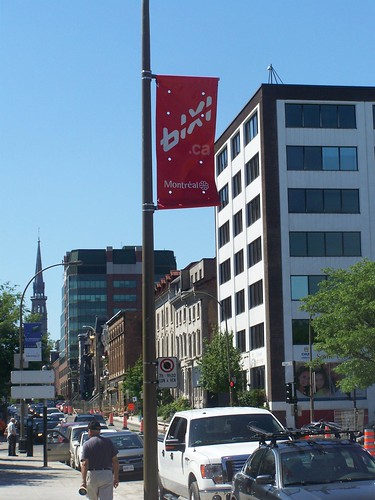
A street banner promoting the Bixi bicycle sharing program in Montreal

Now us Washingtonians get bent out of shape when Bixi claims that they are the first public bikesharing program in North America, when the SmartBike program in DC was first. BUT, being here, I guess I see their point. The DC program is a pilot, with a handful of stations (something like 10) and maybe 150 bikes--which are barely use as each bike experiences fewer than 2 trips per day, while the Montreal system is widespread with 400 stations and 5,000 bicycles, and they are set up to be used not just by subscribers--the DC system is restricted to subscribers, but by anyone with a credit card, someone like me, who is visiting...
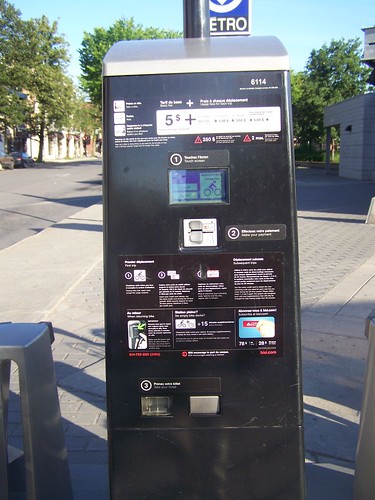
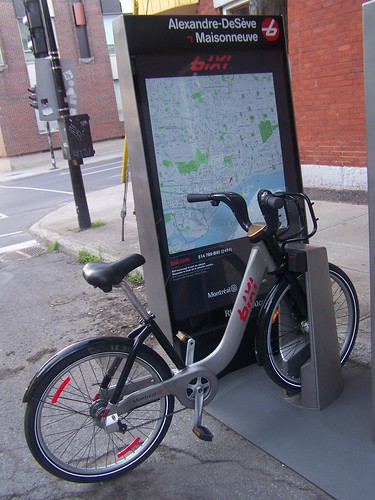
Bixi terminal

Bixi station map
Bixi station map.

The stations are placed no more than 300 meters (1,000 feet) apart. Because Montreal is actually made up of separate arondissements, kind of like towns, parts of the city are not covered by Bixi because of lack of density or because the arondissement, such as Westmount, see `Westmount in 'no rush' for Bixi` from the Montreal Gazette, does not participate.

If you know how to bike, how to use a credit card, how to `consume` a city, and how to read a map (although it took me a few minutes to figure out how to unlock a bike from the station) you can use Bixi whether or not you are a `member`.
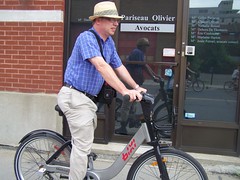
Me on a Bixi
(I definitely wouldn`t be able to get my photo in one of the pretty riding blogs.)

It really allows you to explore far more of a city--block by block--than you can by regular transit. (Now there are reasons why such a system works better in Montreal than in a place like DC but I`ll write about that when I get back.)
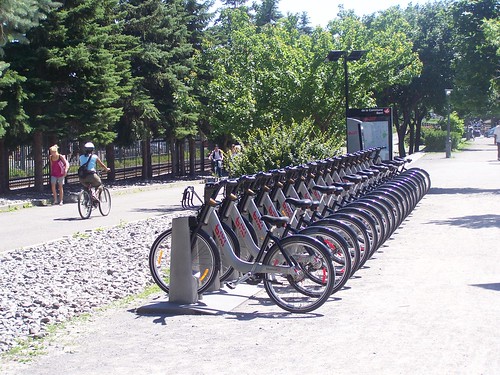
Bixi station approaching the Old Port of Montreal
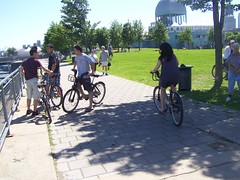
A gaggle of Bixi cyclists in the Old Port of Montreal
Above and below, Bixi cyclists in the Old Port of Montreal.
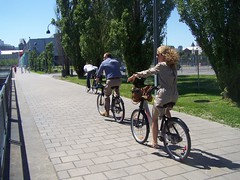
Bixi bicyclists in the Ports of Old Montreal

Woman on a Bixi in Victoria Square, Montreal
Woman on a Bixi in Victoria Square, Montreal.

As an indicator of a high rate of bicycling--biking is part of how people get around day-to-day, what some people call `culture`but what I think of as bicycling as a part of every day mobility behavior or ``way of life``--that there are public bike racks in neighborhoods, because of a need to secure bikes and people living in smaller places or on upper floors, when bringing a bike in can be a problem.
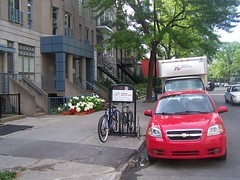
There are so many bicyclists in Montreal that there are public bike racks installed in neighborhoods

Finally, the thing that puts Montreal to the number one position may be the fact that
Vélo Québec, the city and provincial bicycle advocacy organization, has the makings of the `bike center` that WashCycle got our hopes up on in an April fools blog entry. The VeloQuebec office on Rue Rachel, across from Fairmount Park is also a cafe, cycle bookstore, and cycle travel office.
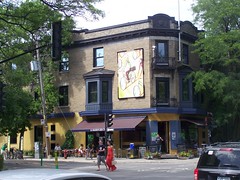
The Velo Quebec office is also a cafe and bookstore serving bicyclists

Inside the VeloQuebec cafe

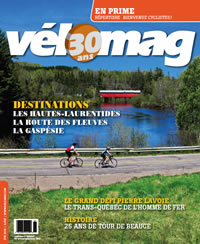
Vélo Québec also publishes a full-blown magazine, VeloMag, in French of course. The latest issue comes bagged with maps of various cities, such as Quebec City, which paid to include their bike maps as advertisements in the issue.
-

And Vélo Québec also publishes a fabulous (but expensive) manual for bike and pedestrian planning, (in French and English editions) which covers just about everything, even things I hadn`t considered when producing the forthcoming Western Baltimore County Pedestrian and Bicycle Access Plan...
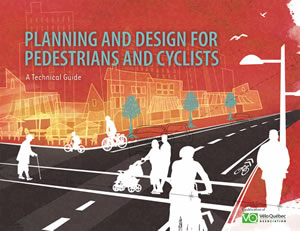

Maybe all of that doesn`t make Montreal the number one city for bicycling in North America--I did notice that they only provide certain services (Bixi and bike lanes) from April to November, which might mean that they don`t do snow clearance of bike lanes and paths in the winter--but it has to come pretty close.

Speaking of John Pucher, here is one of his articles that I have to read...

"Why Canadians Cycle More than Americans: A Comparative Analysis of Bicycling Trends and Policies," Transport Policy, May 2006, Vol. 13, pp. 265-279 (with Ralph Buehler). Click here for PDF.

Labels: , ,

City division: VH1`s `Do Something` Awards

VH1’s 2010 Do Something Awards focus on promoting civic involvement. In the `city` division, Austin, Texas is one of the nominees for the city's efforts in encouraging its residents to use biking as a primary form of transportation. Portland (local foods), Boston (teaching-engaging youth), Greensburg, KS (sustainable redesign post-tornado), and Salt Lake City (community volunteerism) are the other nominees.

According to VH1:

The DoSomething Awards honor those who are making a difference in the world. There are an additional four cities in the running to win under the same category.

The VH1’s 2010 Do Something Awards will be broadcast live, Monday, July 19 at 9/8c.

Labels: , ,

Thursday, July 01, 2010

Blog stuff

I have been writing a lot less for awhile, because I had been spending 5 hours/day traveling to and from my job via public transit and bicycle, and that cut into my "free time." Plus over the last month especially, I had been focused on wrapping up the Western Baltimore County Pedestrian and Bicycle Access Plan, which had a drop dead due date of 6/30--as did my term as bicycle and pedestrian planner, which was a grant funded position co-terminate with the production of the plan.

It'll be a few days before I start blogging again though, partly because despite the efforts of computer technicians, Verizon technicians, etc., my home-based Internet access isn't working at the moment, and it may be some time before it does.

Labels: